What Is Ring Lock Scaffolding and Why Is It Widely Used in Modern Construction?
- Key Challenges in Today's Construction Industry That Scaffolding Systems Must Solve
- How High-Precision Ring Lock Scaffolding Improves Construction Speed and Jobsite Safety
Why Sucoot Specializes in High-Precision Ring Lock Scaffolding for Global Projects?
- How the Ring Lock System Enables Fast, Error-Resistant Assembly on Construction Sites
- One Modular Ring Lock System, Multiple Series: How Different Specifications Serve Different Load Requirements
How Precision Engineering and International Standards Ensure Ring Lock Scaffolding Safety
- Why Connection Tolerance Matters: How 1.8 mm Precision Preserves Structural Load Capacity
- What Load Capacity Can Ring Lock Scaffolding Support? 72-Ton Heavy-Duty Performance Explained
- Where High-Precision Ring Lock Scaffolding Is Used: Applications Across Construction and Industrial Sectors
What Is Ring Lock Scaffolding and Why Is It Widely Used in Modern Construction?
Key Challenges in Today’s Construction Industry That Scaffolding Systems Must Solve
- Labor Shortage:Severe labor shortages are slowing project delivery worldwide. According to the 2024 Workforce Shortage Analysis by the Associated Builders and Contractors (ABC), the U.S. construction industry alone will need to attract an estimated 501,000 additional workers beyond normal hiring levels to meet nationwide demand.
- High Jobsite Risk : According to the U.S. Bureau of Labor Statistics (BLS) data from 2023, Falls, Slips, and Trips accounted for a devastating 39.2% of all construction-related fatal injuries.
- Strict Engineering Compliance:Contractors must meet increasingly complex standards and inspection requirements across EN, ANSI, and AS/NZS systems.
- Schedule Pressure:Contractors face rising pressure to shorten schedules while maintaining strict safety compliance.
Sucoot’s high‑precision Ring Lock Scaffolding provides modern construction with a more reliable and more efficient solution — enabling Build Safer. Build Faster.
How High-Precision Ring Lock Scaffolding Improves Construction Speed and Jobsite Safety
Sucoot’s high‑precision Ring Lock Scaffolding features tight dimensional accuracy and minimal tolerance for smooth, trouble‑free assembly. Using high‑tensile STK500 steel, the system delivers strong, stable, and precisely fitted connections — and is certified under EN12810-1 ensuring compliance with international scaffolding safety standards.
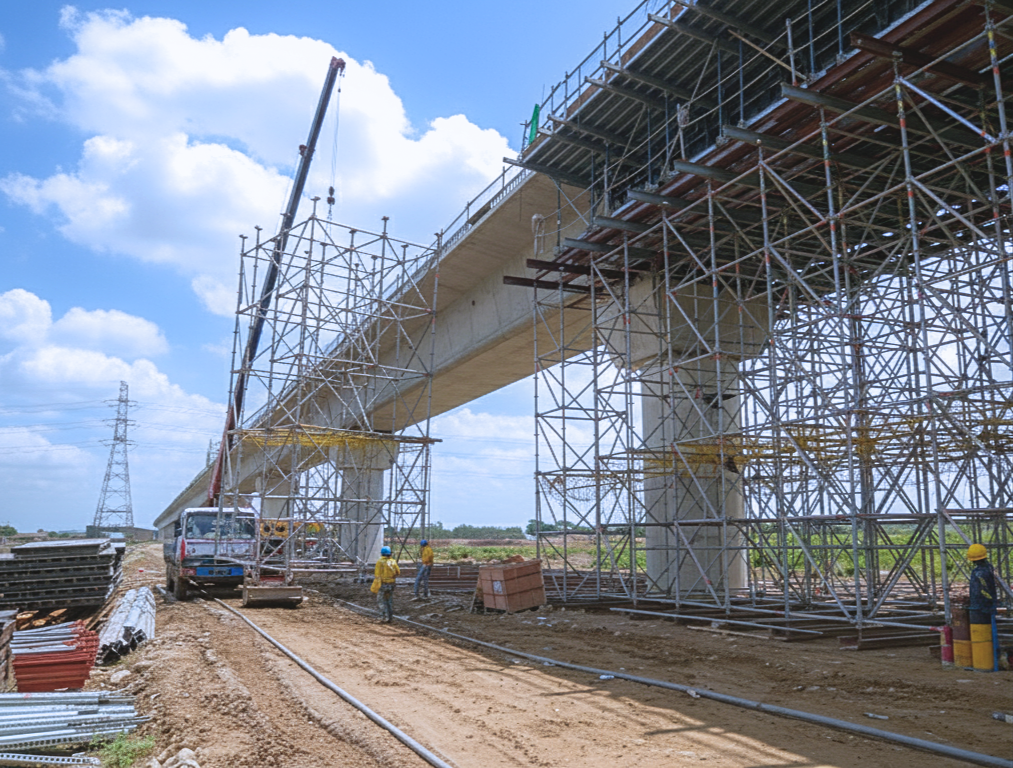
This precision enables entire shoring towers to be relocated as a single unit without dismantling. In civil engineering projects, this block‑shifting method accelerates progress, shortens cycle time, and reduces overall manpower needs.
Real-World Case Study: Block-Shifting Ring Lock Scaffolding in Large-Span Infrastructure Projects
| Item |
Project Details |
| Region |
Taoyuan, Taiwan |
| Project Scope | Long-span bridge shoring for Airport MRT CE02 section |
| Sucoot System Used | Heavy-Duty Ring Lock Shoring Towers (STK500 steel) |
| Construction Method | Block-shifting (crane-lift relocation) |
| Manpower Required | 7 workers |
| Project Duration | 2 years |
| Completion Output | 300 spans completed using only 10 sets of materials, with zero safety incidents |
Efficiency Comparison (Traditional vs Sucoot)
| Workflow Step |
Traditional Dismantle‑and‑Rebuild |
Sucoot Block‑Shifting |
| Tower Handling |
Full dismantle + reassembly |
Lift and relocate as one unit |
| Cycle Time | 5 days per span | 0.5 day per span |
| Efficiency | Slow, repetitive | 10× faster cycle |
| Manpower | 12–16 workers | 7 workers |
This project highlights how Sucoot’s precision‑manufactured Ring Lock Scaffolding can significantly boost construction efficiency compared to traditional systems.
Why Sucoot Specializes in High-Precision Ring Lock Scaffolding for Global Projects?
How the Ring Lock System Enables Fast, Error-Resistant Assembly on Construction Sites
- The Ring Lock system is engineered for intuitive, rapid assembly without complex training.
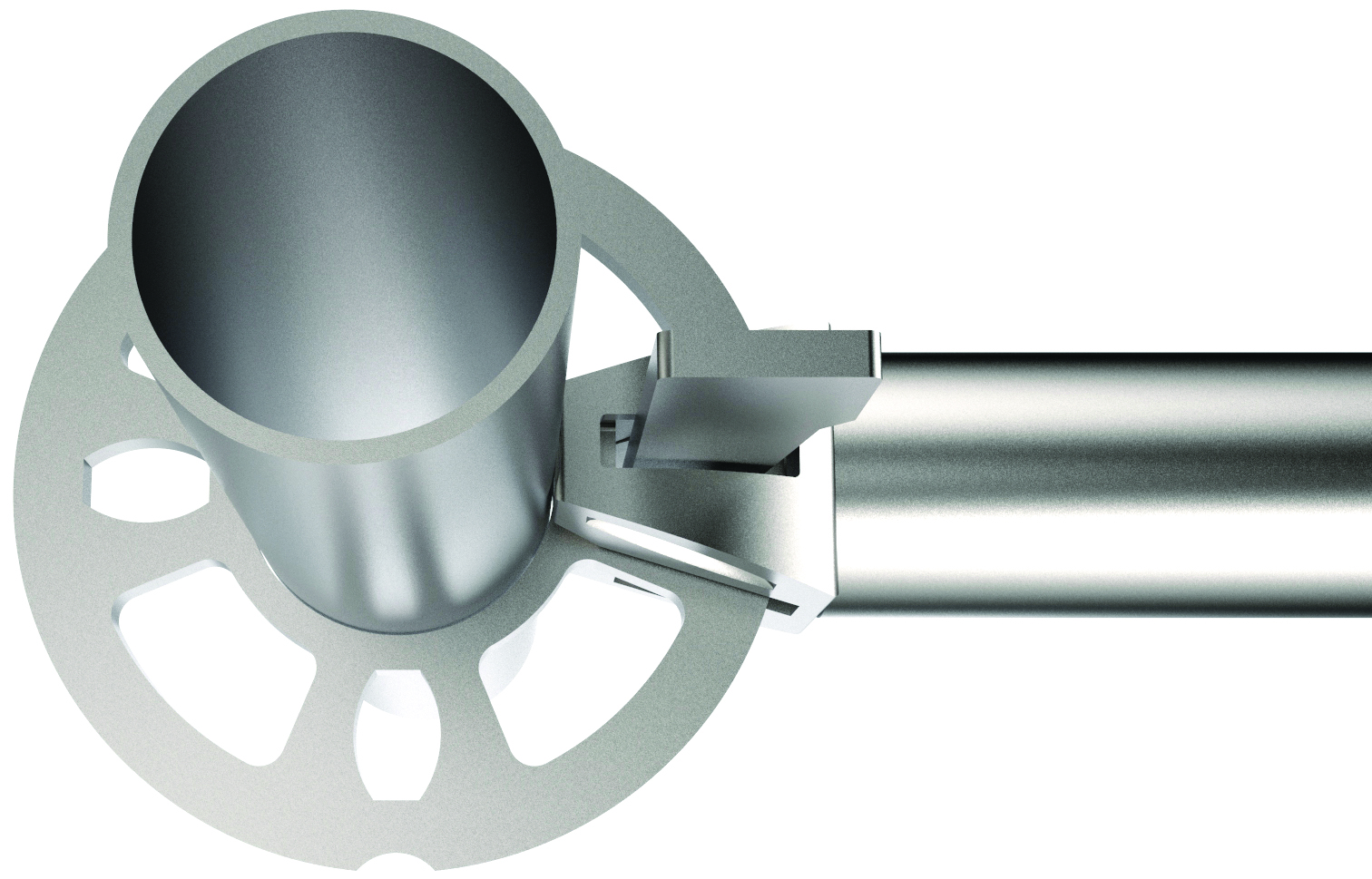
- Ring-and-wedge design allows components to lock securely with a single hammer action.
- No special tools or skilled labor required — any trained worker can assemble the system safely and efficiently.
- Because the assembly method is simple and standardized, site supervisors can easily verify whether the structure is installed according to drawings, ensuring every component is correctly placed and reducing the risk of unnoticed installation errors.
One Modular Ring Lock System, Multiple Series: How Different Specifications Serve Different Load Requirements
Sucoot offers three precision-engineered Ring Lock series to support multiple construction needs.

Ø48.6 × t2.5 mm Light Duty Series
Ideal for façade scaffolding, and construction access platforms.
Ø48.6 × t3.2 mm Standard Series
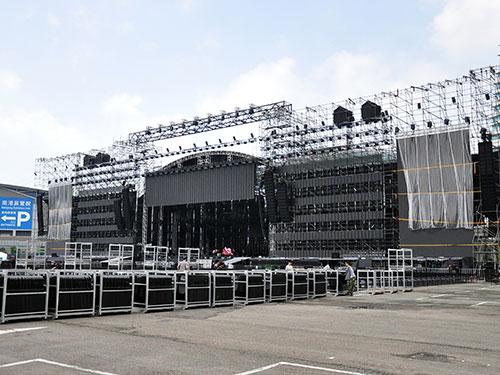
Enhanced strength for stage structures. Thanks to the high precision and high load-bearing capacity of our scaffolding system, it is well suited to support audio equipment, lighting systems, and stage façade decoration elements.

Ø60.2 × t3.2 mm Heavy-Duty Series
Engineered for shoring, bridge works, long-span support, and high-load civil engineering.
All three series share the same modular logic, standardized connections, and 8-direction Rings — allowing crews to learn one system and apply it across multiple applications with higher efficiency and lower training requirements.
Sucoot’s high-strength, high-precision Ring Lock Scaffolding is engineered to handle any elevated work or temporary shoring requirement. Its simple assembly and robust structural performance make it suitable for a wide range of industries — from bridge works and petrochemical plants to aircraft maintenance. The system adapts effectively to uneven terrain, curved surfaces, irregular structures and suspended structures, providing safe and reliable access and shoring in complex jobsite conditions.
How Precision Engineering and International Standards Ensure Ring Lock Scaffolding Safety
Why Connection Tolerance Matters: How 1.8 mm Precision Preserves Structural Load Capacity
Sucoot’s Ring Lock Scaffolding is manufactured with a connection tolerance within 1.8 mm, enabling the entire scaffold structure to maintain vertical deviation within 0.3%. This precision ensures:
- Stable vertical alignment, even when towers reach significant heights.
- Balanced load transfer, preventing uneven stress that can weaken structures.
- Fast, smooth assembly, because tightly controlled tolerances avoid misalignment or forced fitting.
What Load Capacity Can Ring Lock Scaffolding Support? 72-Ton Heavy-Duty Performance Explained
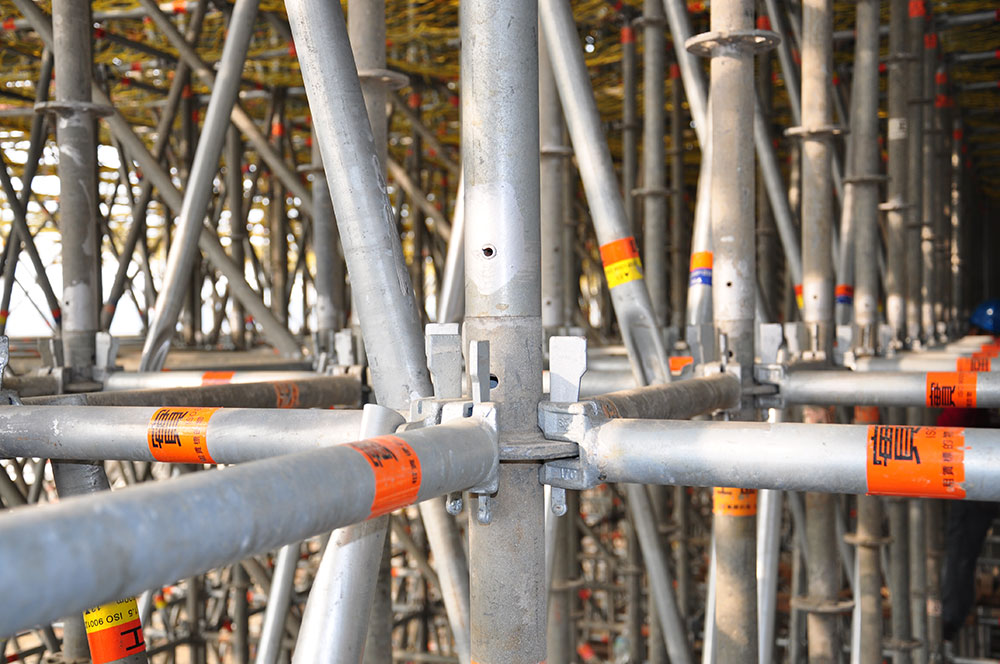
Sucoot’s Ring Lock Scaffolding is engineered with high‑tensile STK500 steel and precision‑controlled tolerances to deliver exceptional load‑bearing performance. A single shoring tower has been third‑party tested to support 72 tons, providing engineers with a reliable, verifiable structural capacity.
This high strength means that for the same required shoring load, Sucoot can achieve the design capacity with fewer materials compared to lower‑strength or low‑precision systems. Fewer components also mean:
- Faster assembly and dismantling
- Lower labor requirements
- Reduced transport and storage costs
- Higher turnover efficiency on fast‑paced projects
Because Sucoot’s towers maintain true load‑bearing capacity closer to the original engineering design, offer long‑term reusability, durability, and superior return on investment. Over multiple projects, contractors gain substantial lifecycle value — making Sucoot’s Ring Lock Scaffolding a smart, cost‑effective long‑term investment.
High Precision and High Strength — Proven Across Multiple Industries
Sucoot’s three Ring Lock Scaffolding series are widely used across civil engineering, industrial, and infrastructure sectors.
- High‑rise façade & access scaffolding — Our 48.6 series provides safe, stable access even on buildings with irregular geometry.
- Bridge shoring & tunnel support — The heavy‑duty 60.2 series delivers high load capacity required for long‑span civil works.
- Large‑scale performance stages — The 48.6 × 3.2 mm series is ideal for stage grids for loading concert equipment.
- Petrochemical, refinery, power‑plant maintenance & construction — All series adapt to curved tanks, uneven terrain, and confined industrial spaces.
Visit Sucoot’s Industry Applications page to explore how our Ring Lock Scaffolding is used in your targeted industries.
Need a scaffolding solution fast?
For immediate, direct support, reach out to us now. Our sales and engineering design teams are ready to collaborate, understand your unique project needs, and promptly provide the most suitable and safe scaffolding plan. Contact us directly today.
FAQ
Connection tolerance directly affects load transfer and structural stability. Larger tolerances create gaps at joints, leading to uneven force distribution and reduced effective capacity. Testing and field experience show that maintaining tolerance within 1.8 mm allows the scaffold to perform close to its engineered design.
Yes, when precision, material strength, and engineering design are properly applied. High-precision Ring Lock systems allow shoring towers to be lifted and relocated using block-shifting methods, reducing dismantling work, labor demand, and construction cycle time.
Yes, provided the correct series and configuration are selected. Lighter configurations are used for access and façade work, while heavy-duty series are engineered for shoring, long-span slabs, and bridges. Engineering review is essential to ensure safe application.
Not necessarily. For small, low-height, or one-time projects, simpler systems may be sufficient. Ring Lock scaffolding delivers the most value where safety, speed, repeated use, or complex site conditions are involved.
Initial project height, load type, ground condition, and site constraints are sufficient to begin system planning. Detailed drawings and calculations can be developed during the engineering review stage.